How to start a milk tea business: menu, design, first month
How to start a milk tea business in the Philippines: franchise or own brand, a menu that sells, small-shop design, delivery apps and a one-page plan.
Mapkita Team9 min read
Key takeaways
- A franchise sells you tested recipes, suppliers and a known name in exchange for fees, rules and less freedom. Your own brand is the reverse.
- Start with 8 to 12 drinks in three or four families, two sizes and four to six add-ons. A short menu is faster to make and easier to read from the queue.
- Lay out the counter so people order and pay at one end and pick up at the other, with the menu readable from where the queue starts.
- Plan around payday weekends and, near schools, the DepEd calendar: school year 2026 to 2027 runs from 8 June 2026 to 8 April 2027, on three terms.
Starting a milk tea business: what decides if it works
A milk tea business works when the shop sits where thirsty people already pass, makes the same drink the same way every time, and gets a cup into a hand in a few minutes. Everything below serves those three things.
This guide is for a small milk tea shop or kiosk with one or two people behind the counter. Before you sign a lease, check the spot itself.
- Who passes, and when: count people walking by at 10AM, 3PM and 6PM on a weekday and on a Saturday.
- What they need: students and office workers on a break want a quick cup; mall and park crowds may wait for something to photograph.
- Who's already there: note every milk tea shop within a 10-minute walk, what it sells and how long its queue gets.
- Shade and space: somewhere people can stand and wait without blocking a door or the sidewalk.
Milk tea franchise or your own brand?
A milk tea franchise and your own brand are different bets, and neither is always cheaper. Compare the real quotes you get, line by line, using the trade-offs below.
Before you sign with any franchisor, the Philippine Franchise Association's advisory suggests asking who is behind the brand and whether it has a track record in franchising. It also asks whether the franchisor owns its trademark, whether the agreement and operations manual are detailed, what training and support you get, and whether the franchisor is a member of a legitimate franchise association. It warns against pressure tactics and offers that are too good to be true. Visit two or three branches and talk to their owners.
- Recipes: a franchise gives you tested recipes and training. With your own brand you develop, test and standardise them yourself.
- Supplies: ask whether you must buy from the franchisor. Your own brand picks its suppliers, and has to find reliable ones.
- Name: a franchise may bring a name people already know. Your own brand starts from zero, but every regular and every review is yours.
- Rules: ask how much of the menu, the look and the promos a franchise lets you change. Your own brand can change any of them tomorrow.
- Costs: a franchise has an upfront fee and may charge royalties or marketing fees; the contract states them. Your own brand pays for its own recipes, design and mistakes.
- Territory and exit: read what the contract says about another branch opening near you, the contract length, renewal, and what happens if you close.
Milk tea menu: how many drinks, sizes and add-ons
A short milk tea menu is faster to make, easier to read from the queue, and wastes fewer ingredients. Start small and add drinks only when customers keep asking for them.
After four weeks, check your sales notebook. Drop any drink that sells only a few cups a week and try one new flavour in its place. Menu design covers how to lay out the board and the prices.
- 8 to 12 drinks in three or four families: classic milk tea (wintermelon, okinawa, brown sugar), fruit tea, cream or cheese-topped, and one or two non-tea drinks, like chocolate, for kids.
- Two sizes, such as medium and large. A third size adds a cup, a lid and another price to every line of the board.
- Four to six add-ons: pearls, nata de coco, pudding, cream cheese, popping boba, crushed cookies.
- Sugar and ice levels written once at the bottom of the board (0, 25, 50, 75 or 100% sugar; less ice or normal), so you don't explain them every time.
- A number for every drink. "Isang number 3, large, 50% sugar" is faster for you and easier for a shy customer.
- A best-seller board: your top three drinks with real photos, at eye level near the counter. Change it when the ranking changes.
Milk tea shop design for a small space
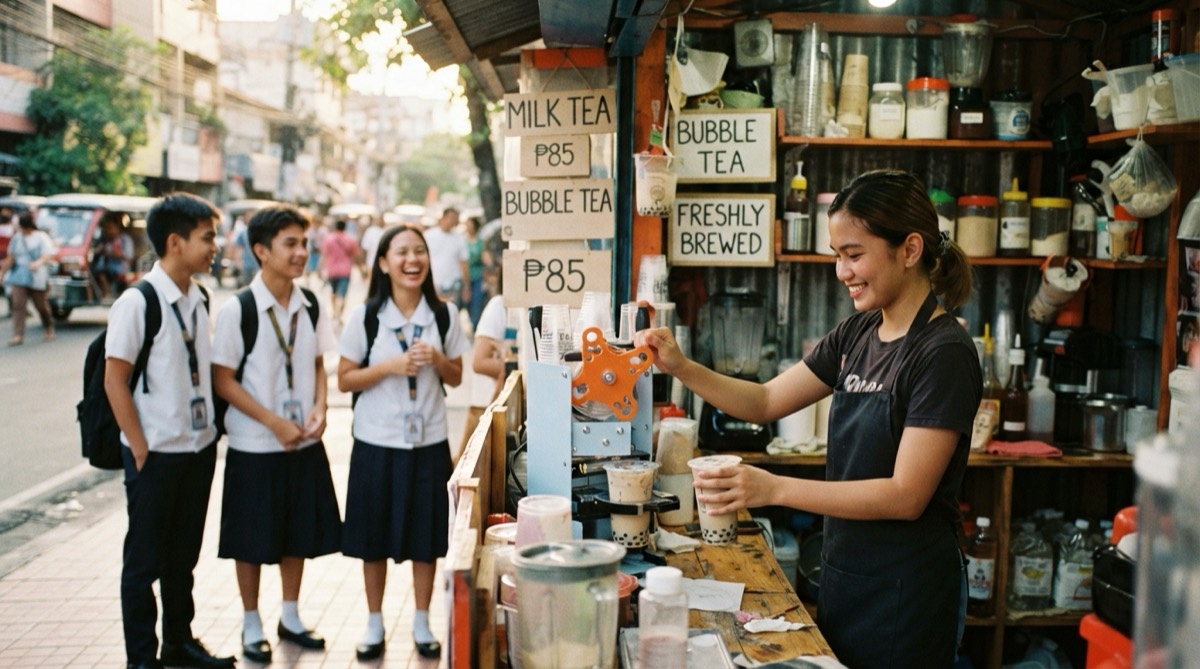
Most milk tea shops are a counter and a queue. Good milk tea shop design makes three things easy: reading the menu, ordering and paying, and picking up without bumping into the next person.
- Order and pay at one end of the counter, pick up at the other, with the making in between.
- A menu board readable from where the queue starts. Stand there and read it: if you can't read the prices, the letters are too small or the board too busy.
- Queue space that doesn't block the door, the sidewalk or the shop next door. Tape on the floor shows people where to stand.
- A photo spot: one wall with your name or logo, good light and a ledge to rest a cup on. When people post their drink, your name is in the picture.
- Storage under the counter for cups, lids, straws and sealing film, so the counter stays clear.
- Power planned before you build. A cup sealer, fridge, freezer, blender and lights on one circuit can trip the breaker at the busiest hour, so have an electrician check it.
- A brownout plan: a cooler with ice and a rechargeable light, so you can keep serving.
Milk tea shop name ideas that work
Good milk tea shop name ideas are short, easy to say in Taglish and easy to type into a GrabFood or foodpanda search. Most follow one of the patterns below.
Then check it. Search the name on Google Maps, Facebook, GrabFood and foodpanda to see if a shop near you already uses it, and search IPOPHL's trademark database to see if someone has registered it as a trademark. A name you can't keep means reprinting everything.
- A tea word plus a local word: Tea, Cha or Boba with a Filipino word or a place name.
- Place-based: your street, town or landmark plus Tea House or Milk Tea.
- A playful Filipino word or pun that customers will enjoy repeating.
- Owner or family: your nickname plus Tea, or Tea ni plus a name.
Delivery apps, payday and the school calendar
Delivery apps reach people who never pass your counter. GrabFood and foodpanda each have their own sign-up. Check the current commission in the merchant contract or dashboard before you set your app prices. Pack for the ride: sealed cups, a cup holder or a snug bag, and a sticker with your name. How ratings work on each app is in GrabFood merchant ratings and foodpanda merchant ratings.
Demand also follows money and timetables. Many workers are paid on or around the 15th and the 30th, so plan promos for those weekends. Near a school, your weekdays follow the school calendar. DepEd's order for school year 2026 to 2027 sets classes from 8 June 2026 to 8 April 2027, on a new three-term calendar with a block between terms. Mark those weeks and the long break after April, and plan staff and stock around them.
Your first month as a milk tea business
The first month of a milk tea business is for two things: getting each drink right every time, and turning first-timers into regulars. The checklist every new shop needs, from the sign to first reviews and the day-30 check, is in how to start a business in the Philippines. How to attract customers has low-cost tactics. These are the milk tea parts.
- Week 1: a soft opening for neighbours and nearby offices or schools, with small tasting cups. Watch which drinks people come back for.
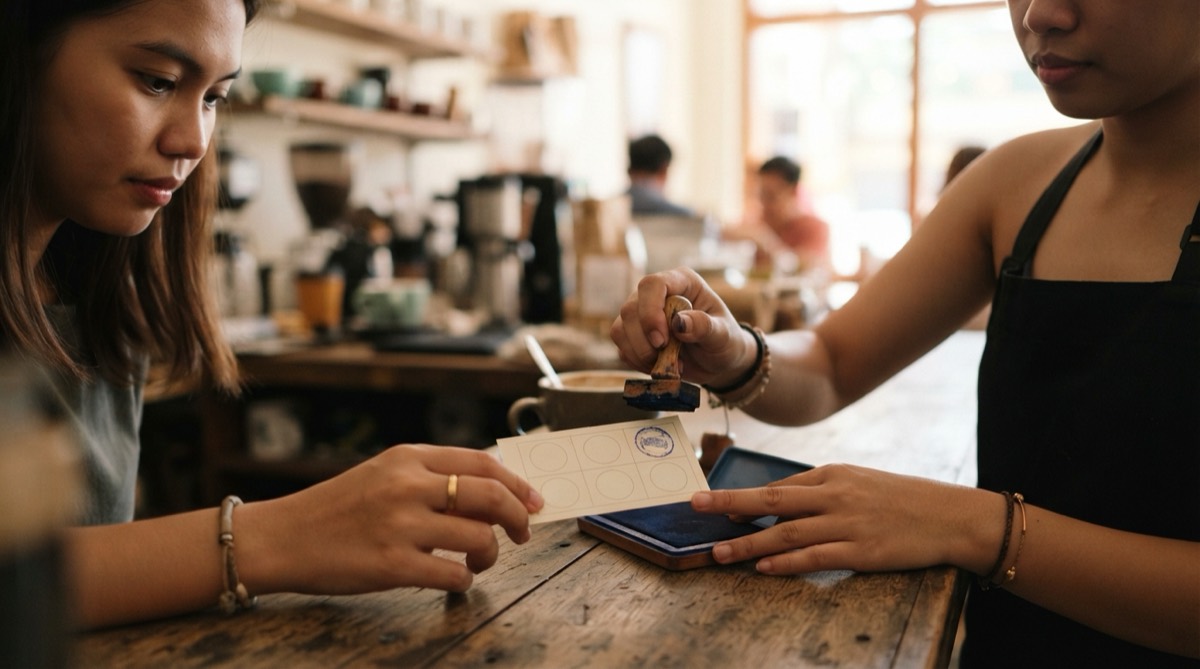
- Week 1: stamp cards from the first day. Ten stamps for a free drink is easy to remember, and the free loyalty card maker prints ten cards to an A4 sheet. A loyalty program for a small shop covers what reward to pick.
- Week 2: time yourself. Count cups per hour at the peak and how long one drink takes. If the queue stalls, cut the menu or prepare tea and pearls in bigger batches before the rush.
- Week 2: photos of your real drinks for Google Maps, Facebook and the delivery apps. Food photography shows how to shoot them with a phone.
- Every week: stamps are for purchases only. Never give a stamp or a free add-on for a review on Google, because Google doesn't allow rewards for reviews.
- Week 4: open the notebook. Best and worst sellers, busiest hours, how many stamp cards came back. Drop one slow drink and adjust staff hours.
A milk tea business plan on one page
A milk tea business plan doesn't need to be a thick document. One page you can read in two minutes is enough to decide, to show a partner or a lender, and to check against reality after a month. Copy these headings and fill each one with your own numbers and quotes.
- Concept: one sentence on who you serve, what you sell, and why they'll pick you.
- Location: the address, who passes and when, and the milk tea shops within a 10-minute walk.
- Franchise or own brand: which one, and your three reasons.
- Menu: number of drinks, sizes and add-ons, and your three planned best sellers.
- Suppliers: where the tea, milk, pearls, cups and sealing film come from, with a backup for each.
- Equipment: sealer, fridge, freezer, blender, dispensers and a POS or notebook, with quotes.
- Startup costs: every quote added up, plus cash to cover the first slow months.
- Cost per cup: ingredients, cup, lid, straw and film for your best seller.
- Daily break-even: monthly fixed costs (rent, power, water, pay) divided by what you keep per cup after its cost, then divided by the days you open. That's how many cups you must sell each day.
- Staff and hours: who works when, and who covers when someone is sick.
- First 30 days: soft opening, tastings, stamp cards, Google Maps and Facebook.
- Risks: rainy season, brownouts, a new shop opening nearby, a supplier running out. One line on what you'd do about each.
Frequently asked
- How many flavors should a milk tea shop have?
- Start with 8 to 12 drinks in three or four families, two sizes and four to six add-ons. Add a flavor only when customers keep asking for it, and drop one that barely sells after a month.
- Is it better to get a milk tea franchise or start my own brand?
- A franchise gives you tested recipes, suppliers and a known name in exchange for fees, rules and less freedom. Your own brand gives you control, but you build everything yourself. Compare real quotes and talk to existing franchisees before you decide.
- What should a milk tea business plan include?
- Concept, location, franchise or own brand, menu, suppliers, equipment, startup costs, cost per cup, daily break-even, staff, the first 30 days and the main risks. It fits on one page.
- Is a milk tea business still profitable?
- It can be when the spot has steady foot traffic and each cup leaves enough after rent and pay. Work out your daily break-even in cups before you sign a lease, and compare it with the people who actually pass your spot.
- What is a good name for a milk tea shop?
- One that's short, easy to say in Taglish and easy to type in a delivery app. Check that no nearby shop uses it and that nobody has registered it as a trademark before you print anything.
Let Mapkita do this for you
Mapkita keeps your Google page right, drafts every review reply and asks you before anything goes public. Start with a free check.