Running a carinderia business: menu, display, lunch rush
Running a carinderia business day to day: a menu list that rotates, a food display that sells, what to put on the tarpaulin, the lunch rush, takeout and GCash.
Mapkita Team9 min read
Key takeaways
- Start with six to eight ulam at lunch, at least one from each group: sabaw, saucy, fried and gulay. Add a dish only when a tray sells out early for a week.
- In a turo-turo the display is the menu: cover every tray, and label each one with its name and price on the customer's side.
- The WHO advises keeping cooked food above 60°C before serving and not leaving it at room temperature for more than 2 hours, so cook in waves, not all at dawn.
- At noon, one person scoops and another takes payment. Fixed combos and pre-portioned rice keep the line moving.
Running a carinderia business, day to day
A carinderia business runs on three things: food that's ready when people are hungry, a display that sells it without words, and a line that moves at noon. Get those right and the rest is cooking.
A typical day near offices, schools or a terminal looks like this; shift the hours to fit your street. Cook in waves, not all at once.
- 4AM to 6AM: palengke run for the day's meat, fish and vegetables, then start the sabaw and the dishes that take longest.
- 6AM to 9AM: breakfast. Silog, lugaw, champorado, pandesal and coffee for workers and students.
- By 10:30AM: lunch trays out and labelled. Fry last, so the fried dishes are still crisp at noon.
- 11:30AM to 1:30PM: the lunch rush. Everyone on the counter, and no new cooking unless a tray runs out.
- 2PM to 5PM: merienda. Pancit, palabok, turon, banana cue, kakanin.
- 5PM to 7PM: dinner and takeout for people going home, from a smaller second batch of best sellers.
- Closing: count the cash and GCash, note what sold out and what was left, and plan tomorrow's menu from that.
A carinderia menu list that rotates
A good carinderia menu mixes groups, so every customer finds something, and rotates, so regulars don't get bored. Build each day from the groups below and keep two or three best sellers on every day.
How many dishes? Start with six to eight ulam at lunch, at least one from each group. More trays mean more leftovers, and leftovers are where carinderias lose money. Add a dish only when a tray sells out before 1PM for a week.
For the rotation, keep adobo, one fried dish and one vegetable every day and rotate the rest. Monggo on Fridays is a habit in many neighbourhoods; find your street's version of that. Write the week's menu on a board so regulars can plan.
- Sabaw: sinigang, tinola, nilaga, and bulalo on cool, rainy days.
- Saucy ulam: adobo, menudo, kaldereta, afritada, bicol express.
- Prito: fried fish, fried chicken, lumpia, tortang talong.
- Gulay: pinakbet, ginisang monggo, chopsuey, laing, ginataang kalabasa.
- Budget ulam: giniling, ginisang sayote, tortang giniling, for customers counting coins before payday.
- Merienda: pancit, palabok, turon, banana cue, kakanin. Cook these for the afternoon, after the rice crowd has gone.
Carinderia food display and design ideas
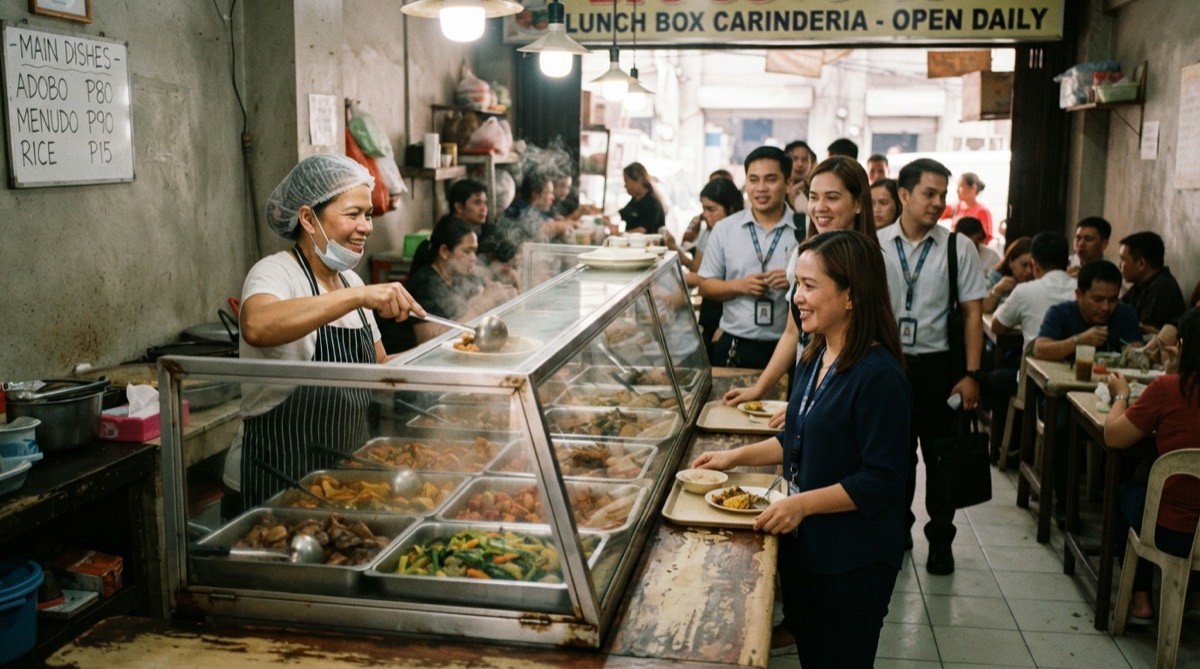
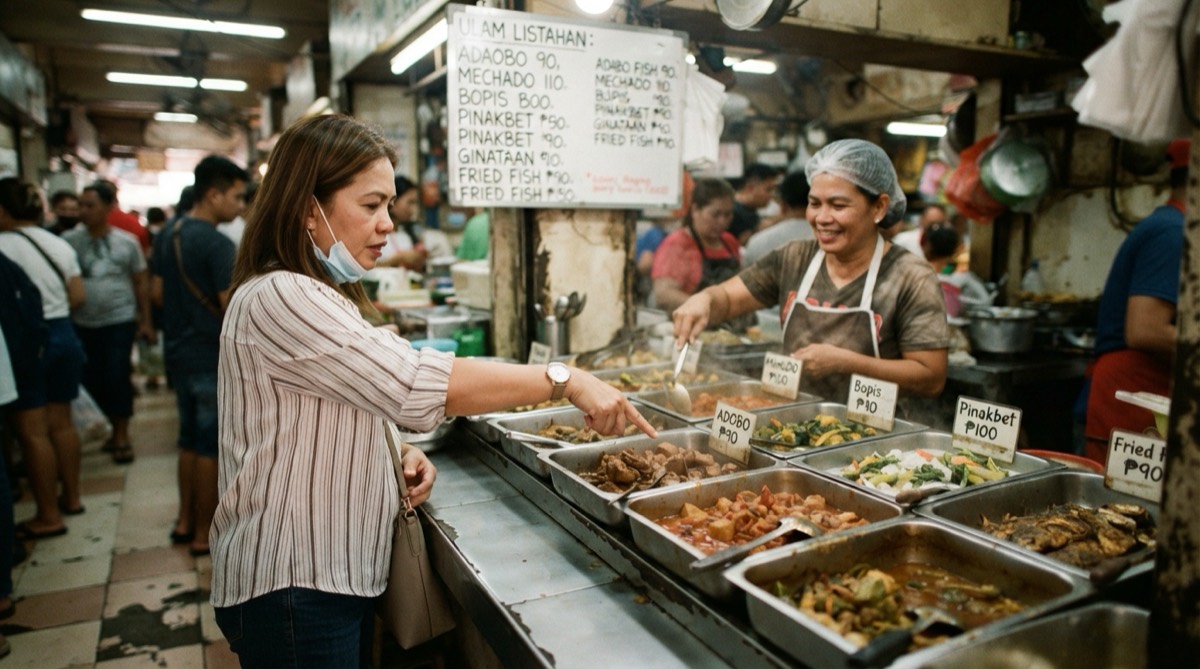
In a turo-turo, the display is the menu: customers point at what they want. It has to answer three questions at a glance. What is it, how much is it, and is it fresh? The carinderia design ideas that help sales are about flow around it: where people queue, point, pay and eat. Sketch it on paper before you move a table.
Food safety here is common sense, and the WHO's Five Keys to Safer Food fits it on one page. Keep cooked food piping hot, above 60°C, before serving. Don't leave cooked food at room temperature for more than 2 hours. Plan your batches around those two rules.
- Cover every tray with glass, a lid or a food cover. It keeps flies and dust off, and customers notice.
- Label every dish with its name and price in big letters, facing the customer. A card on a stick is enough. Nobody should have to ask.
- One serving spoon per tray, so sauces don't mix.
- One direction: best sellers where the line starts, rice and the cashier at the end. The line shouldn't block the door or the people eating.
- Trays facing the street or the door, under bright, warm light. Food in a dim corner looks old.
- Refill in small batches. A half-full tray of fresh adobo looks better than a full one cooked at dawn.
- Keep raw meat and fish in the kitchen, away from cooked food, with their own knives and boards.
- Wash hands before serving and after touching raw food or money, and give customers a sink or water dispenser with soap.
- Long tables and benches, which seat more people at lunch, and surfaces you can wipe between customers.
Carinderia tarpaulin design and name ideas
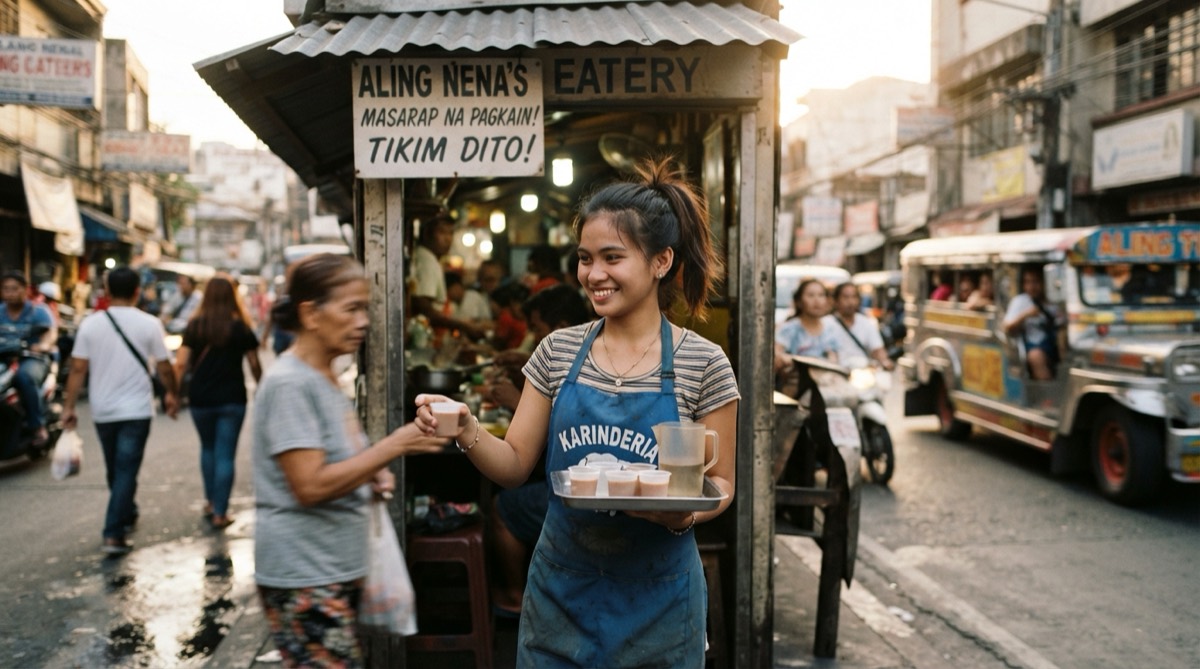
A carinderia tarpaulin has one job: tell someone across the street what you are and that you're open. Put the items below on it, biggest first. If you print prices, print only the ones you can keep for a year, because a tarp outlives a price list.
Use dark letters on a light background or the reverse, and avoid red on green. Before you print, look at the design on your phone at thumbnail size. Whatever you can't read there, nobody will read from across the street. Store hours signage and menu design have more on readable signs.
If you still need a name, most good carinderia name ideas follow a pattern. Try owner or family (Kusina ni [name]), place ([street] Eatery, Kainan sa [place]), a flavour word plus Kainan, or your signature dish ([dish] House). Pick one that's easy to say on the phone and that no carinderia near you uses; search Google Maps and Facebook first. On Google, use the name exactly as on your sign: Google's Business Profile guidelines don't allow extra words like "best lutong bahay in Cubao" in the name.
- Your name, in the biggest letters.
- What you sell, in two to four words: "Lutong Bahay" or "Ulam, Silog, Merienda".
- Your hours: "Open 6AM to 8PM, Mon to Sat".
- How to pay: "GCash and Maya accepted".
- A number for orders: "Order ahead" with your mobile or Messenger.
- One photo of your best seller, two at most. A collage of twenty dishes is unreadable from a distance.
The lunch rush, takeout and GCash at the counter
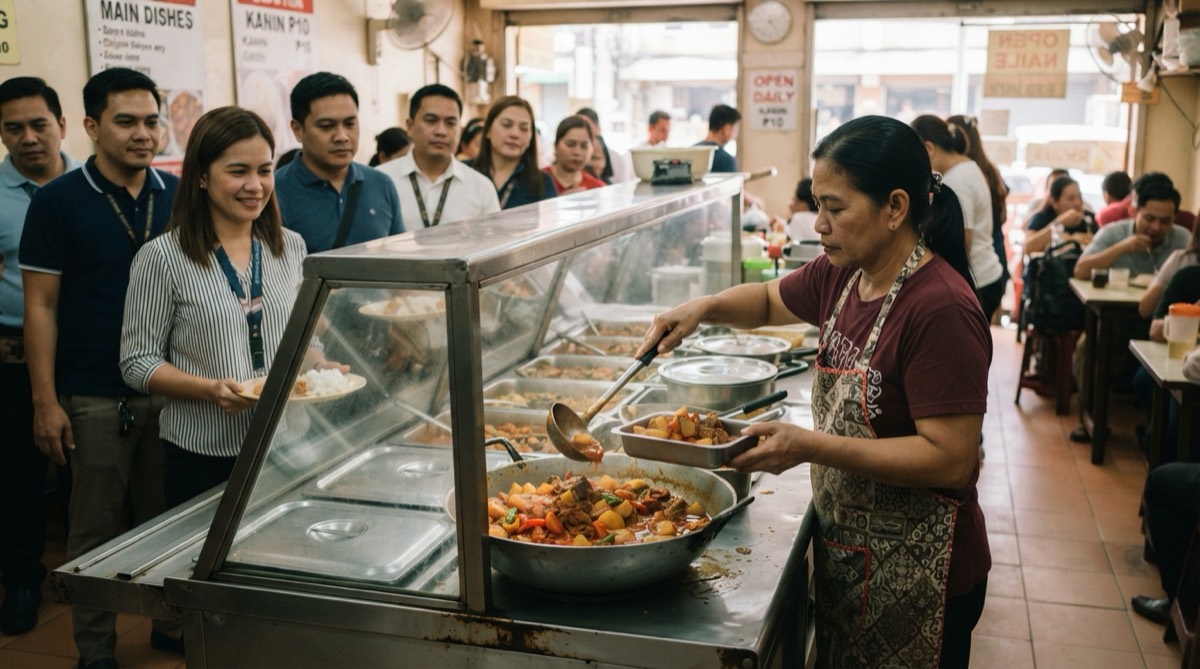
The lunch rush decides your day. Office workers on a short break don't wait long, and a line that doesn't move sends them to the next carinderia.
Packaging has one extra check: local rules. Quezon City, for example, bans plastic bags (Ordinance 2868-2019) and, for dine-in, disposable cutlery, cups, plates, straws and styro (Ordinance 2876-2019). Rules differ from city to city, so ask your city hall what applies to you before you buy a big stock.
- Two people on the counter at noon: one scoops, one takes payment. Never the same hands for food and money.
- Pre-portion rice with a cup or scoop, so every serving is the same and fast.
- Fixed combos, such as 1 rice + 1 ulam and 1 rice + 2 ulam, so people order in one breath and you count change faster.
- Takeout ready before 11:30AM: containers, bags and sauce cups stacked within reach. Sabaw goes in a sealed cup or a tied bag.
- Office pre-orders: take orders on Messenger until 10AM, then pack and label them by 11:30AM.
- GCash and Maya: print your QR, laminate it and put it where people pay. Check the payment notification on your phone before the customer leaves. The free GCash QR sign maker prints it with a Google review QR beside it, and GCash QR codes for business covers the setup.
Carinderia costing: cost per serving and daily break-even
Price from your own numbers, not from the carinderia across the street. Two formulas are enough, and your palengke receipts give you the inputs. Redo them whenever market prices jump, such as after a typhoon.
- Cost per serving: add up everything that went into one pot or tray (meat, vegetables, oil, spices, a share of the gas), then divide by the number of servings it gave. Add the container if it's takeout.
- Overhead per day: the month's rent, electricity, water, gas not counted above, and everyone's pay, including yours, divided by the days you open.
- What you keep per serving: your selling price minus the cost per serving.
- Daily break-even: overhead per day divided by what you keep per serving. That's how many servings you must sell before the day earns anything.
- Example only, with round numbers: if overhead is ₱1,500 a day and you keep ₱25 per serving, you need 60 servings a day to break even. Your own numbers will be different.
- Check it against your sales notebook every week. If you're selling fewer servings than your break-even, fix the menu, the price or the costs before you add dishes.
How much capital do you need for a carinderia?
There's no single figure, because rent and what you already own change everything. Build your number from real quotes for each line below.
- The space: rent and any advance or deposit the owner asks for, plus repairs, paint and lights.
- Cooking: burners, gas tanks and refills, big pots, kawali, knives and boards (separate ones for raw food).
- Display: trays with covers or a glass case, and food warmers or chafing dishes to keep food hot.
- Serving and cleaning: one ladle per tray, rice scoops, plates, cutlery, glasses, tables, benches, soap and covered bins.
- Takeout: containers, bags and sauce cups for the first weeks.
- Signs and payments: the tarpaulin, price labels, a printed GCash or Maya QR, a cash box and a change fund.
- First week's stock: a palengke budget for six days of rice, meat, fish, vegetables, oil and gas.
- A cash cushion: enough to pay rent, gas and stock for the first slow weeks without counting on sales.
Be the carinderia people find when they search near them
People often search for a carinderia near them on Google Maps. To be one of the places that show up, keep your profile complete: the right category, opening hours, photos of the trays and the storefront, and recent reviews. Google has no "carinderia" category, so pick the closest real one, usually Filipino restaurant. The full plan is in local SEO for restaurants and carinderias.
Reviews tell a stranger your food is worth the walk. Ask every customer the same way, with a review card at the counter or in the takeout bag, and offer nothing in return. Then reply to them; review management for restaurants shows how to keep up.
Frequently asked
- What are the best ulam to sell in a carinderia?
- Mix the groups: a sabaw like sinigang or tinola, one or two saucy dishes like adobo or menudo, a fried dish, and a vegetable like ginisang monggo or pinakbet. Keep two or three best sellers every day and rotate the rest.
- How many dishes should a carinderia have?
- Start with six to eight ulam at lunch, at least one from each group. Add a dish only when a tray sells out early for a week, because leftovers cost you more than a short menu.
- What should I put on a carinderia tarpaulin?
- Your name in the biggest letters, what you sell in a few words, your hours, the payments you accept and a number for orders. One photo of your best seller is enough.
- How long can cooked food stay on display?
- The WHO advises not to leave cooked food at room temperature for more than 2 hours, and to keep it piping hot, above 60°C, before serving. Cook in smaller batches and keep the trays hot.
- How much capital do I need to start a carinderia?
- It depends on your rent and what you already own, so build the figure from quotes. Budget for the space, cooking equipment, covered trays and food warmers, serving and takeout supplies, signs, a change fund, the first week's stock, and a cash cushion for the slow first weeks.
Let Mapkita do this for you
Mapkita keeps your Google page right, drafts every review reply and asks you before anything goes public. Start with a free check.