Local SEO for salons and barbershops: a playbook
A start-to-finish playbook for salon and barbershop owners in the Philippines: the categories, services, photos and review habits that fill chairs from Google Maps.
Mapkita TeamUpdated Oct 1, 20265 min read
Key takeaways
- Salons live or die on proximity and reviews. Almost nobody travels far for a haircut.
- List every service separately. "Rebond", "balayage" and "barber fade" are different searches.
- The mirror moment, right after the reveal, is the best review ask in any industry.
- Photos of actual work on actual customers outperform anything staged.
What a salon is really competing for
Nobody crosses Metro Manila for a haircut. Your competition is not every salon in the city. It is the six within about a kilometre, and the deciding search is almost always "salon near me", "barbershop near me" or a specific service plus a place name.
That narrows the job considerably. You are not trying to win the country. You are trying to be the obvious choice inside a small radius, which is a target a single shop can actually hit.
Two things decide it: whether Google understands exactly what you do, and whether you look more trustworthy than the shop two streets over. Everything below is one of those two. If your salon is not on Google Maps at all yet, adding your business to Google Maps comes first.
Get the categories and services right
This is the most useful hour you will spend, because the categories you select affect your local ranking, and most salons get it wrong by being too general.
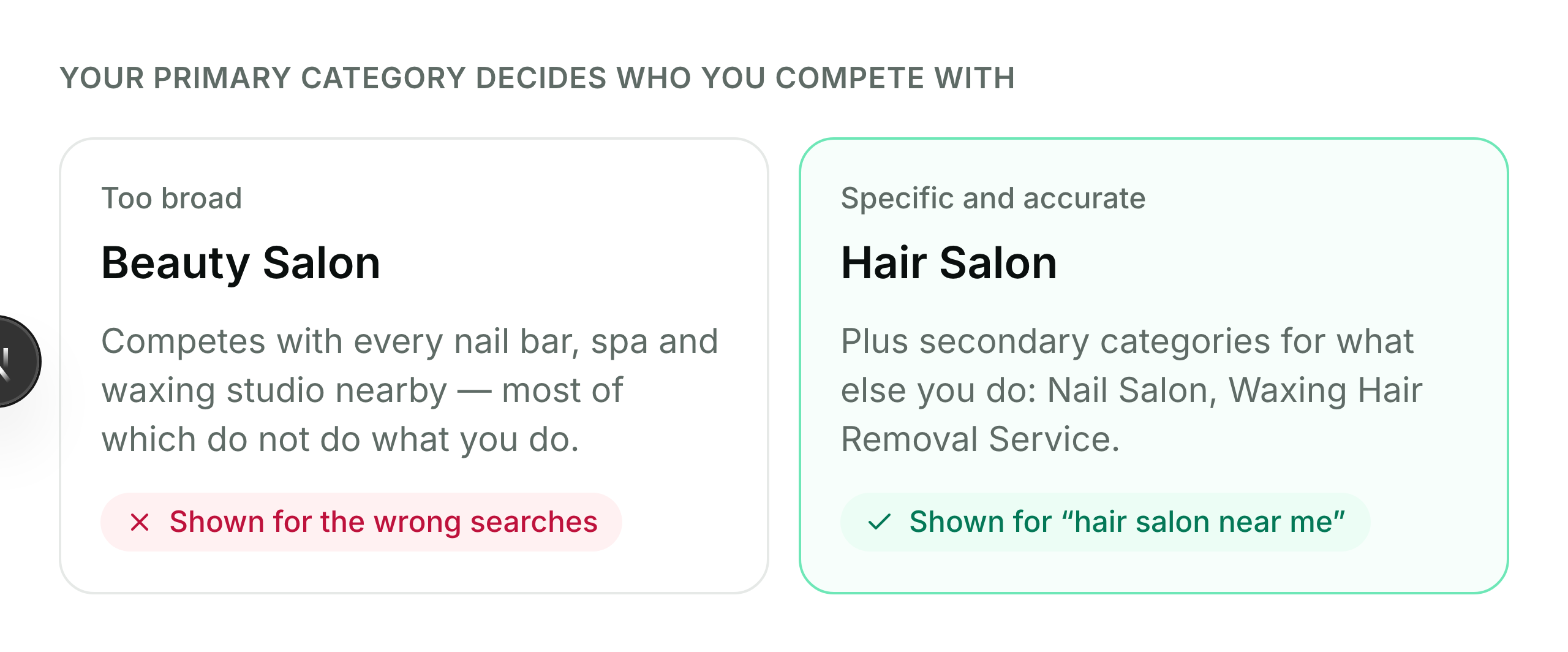
Your primary category should be the most specific accurate option: "Beauty Salon", "Hair Salon", "Barber Shop", "Nail Salon" and "Waxing Hair Removal Service" are different categories that surface for different searches. Pick the one that matches the majority of your revenue, then add the others as secondary categories.
- List services individually, with prices, in your profile's services editor. "Haircut", "Hair Color", "Rebond", "Keratin", "Balayage", "Manicure", "Pedicure", "Foot Spa", "Facial": each is a query someone types.
- Use the words customers use here. People search "rebond" and "parlor", not "chemical straightening" and "beauty establishment".
- Set attributes honestly where Google offers them for your category: appointment required, walk-ins welcome, wheelchair accessible, restroom, air conditioned. Attributes show on your profile in Search and Maps.
- Add a booking link if you use one. It turns a listing into a booking without a phone call, which suits a younger clientele.
Photos: the work, not the room
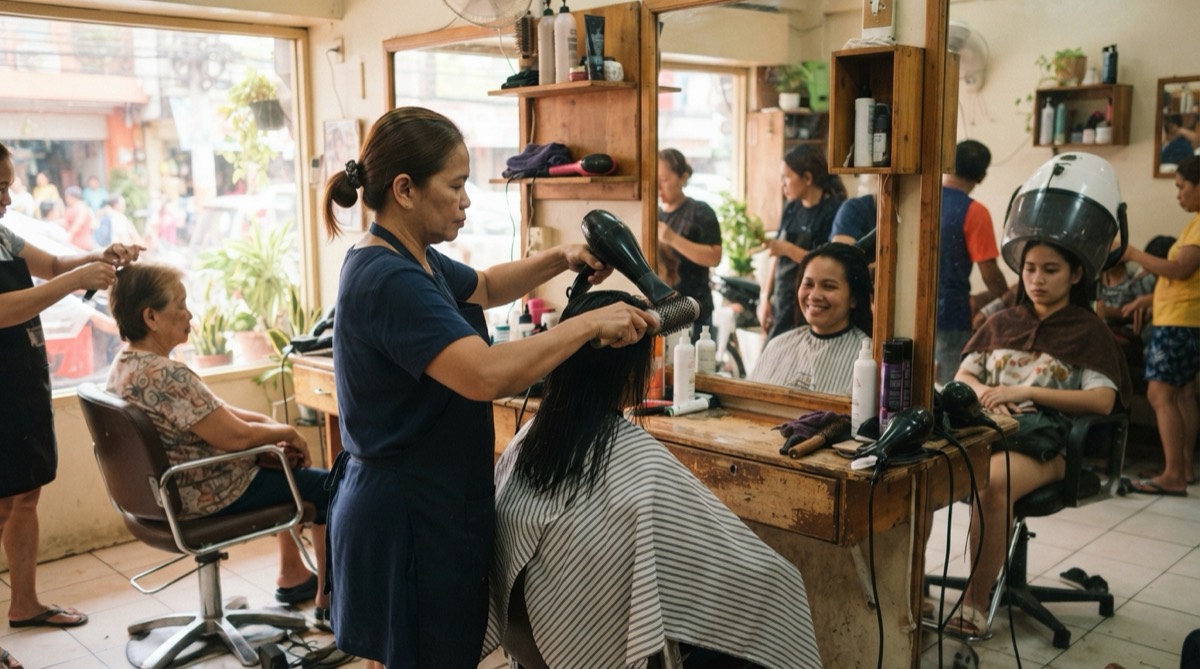
A salon is one of the few businesses where the portfolio is the product. Customers are asking one question (can they do the thing I want on hair like mine?), and only photographs answer it. Google Business Profile photos that bring customers covers light, size and how often to add them.
Shoot the results, with permission, in the same spot near a window every time so the set looks consistent. Before-and-after pairs are the most persuasive images in this industry and almost nobody posts them on Google, only on Instagram.
Cover the range deliberately: a fade, a colour, a rebond, a blow-dry, nails. If every photo is long hair, you will not be chosen by someone wanting a fade. And add the storefront shot: in a strip of similar-looking shops, people genuinely cannot find you without it.
The review habit that actually works here
Salons have the single best review moment of any local business: the mirror. The customer is looking at a result they are pleased with, they are not yet standing up, and they are already facing you.
That is the ask. "If you have a minute, a Google review really helps us. It's the QR on the mirror." It takes four seconds, and it reaches the customer at the moment they are happiest with the result.
Put the QR where the eye already is: on the mirror frame, on the payment counter, on the back of the card. Make it every stylist's habit rather than the owner's job, but don't give stylists a review quota: Google's policy forbids asking staff to collect a set number of reviews. Two or three a week, every week, adds up quickly when most neighbouring shops are not asking at all. Make it with the free review QR code generator; the wording and the rules are in how to ask customers for Google reviews.
One caution specific to this industry: never offer a discount on the next service in exchange for the review. Google's review policy forbids it, and it puts the reviews you already have at risk.
Handling the reviews you will not enjoy
A bad haircut review feels personal because it is about craft. Reply anyway, within a day, and never defend the stylist in public. For the good ones, rotate the Google review reply templates.
The effective move is almost always an offer to make it right, made briefly and warmly. Readers understand that hair is subjective; what they are judging is whether you would look after them if it went wrong. How to respond to negative reviews on Google has a salon template to start from.
Anything alleging injury, such as a burn, a chemical reaction or an allergic response, should never be answered with a template or by AI. Reply with a short acknowledgement and a direct contact, and handle the rest privately.
The weekly routine
None of this works as a one-time project. What separates salons that climb from salons that do not is a small routine nobody skips.
- Monday: check for new reviews and reply to all of them.
- Midweek: add three photos of that week's work.
- Before any holiday: set your special hours, because Holy Week and Christmas are when wrong hours cost the most.
- Monthly: check your hours, services and prices are still true, and search "salon near me" from a few streets away to see where you actually stand.
Frequently asked
- What should my salon's primary category be?
- The most specific one that matches most of your business: "Hair Salon", "Barber Shop" or "Nail Salon" rather than the broader "Beauty Salon", unless you genuinely do all of it. Add the rest as secondary categories.
- How do I get more reviews for my salon?
- Ask at the mirror, right after the reveal, with a QR code within reach. Make it every stylist's habit rather than the owner's, and never tie it to a discount, which breaks Google's rules.
- Should I post my prices on Google?
- Yes. Price is the main reason people hesitate, and a salon that publishes prices attracts customers who have already accepted them.
- How long before I see results?
- Expect a few months before ranking shifts noticeably, assuming a steady review flow and a complete profile. Fixing a wrong primary category or a duplicate listing can show up faster than that.
Let Mapkita do this for you
Mapkita keeps your Google page right, drafts every review reply and asks you before anything goes public. Start with a free check.