How to Reply to a Negative Google Review (Templates)
A calm, practical way to answer a one-star review on Google, with templates in English and Taglish for restaurants, salons and clinics in the Philippines.

Key takeaways
- Reply within 24 hours. Speed is visible to everyone who reads the review later.
- You are writing for the next hundred people who read it, not for the angry customer.
- Never argue the facts in public. Acknowledge, take it offline, then stop replying.
- Answer in the language the customer used — Taglish gets a Taglish reply.
Who you are actually writing to
The customer who left the one star has already decided how they feel. Almost nothing you type will change it. That is fine, because they are not the audience.
The audience is everyone who reads that review in the next two years while deciding whether to book a table, a haircut or an appointment. They will see the complaint and then they will see how the business behaved. A calm, specific, human reply turns a bad review into evidence that you are worth trusting.
This is why the worst reply is not a clumsy one. It is silence, followed by a defensive paragraph three weeks later.
The shape of a good reply
Almost every effective reply has the same five parts, in the same order, and fits in four sentences.
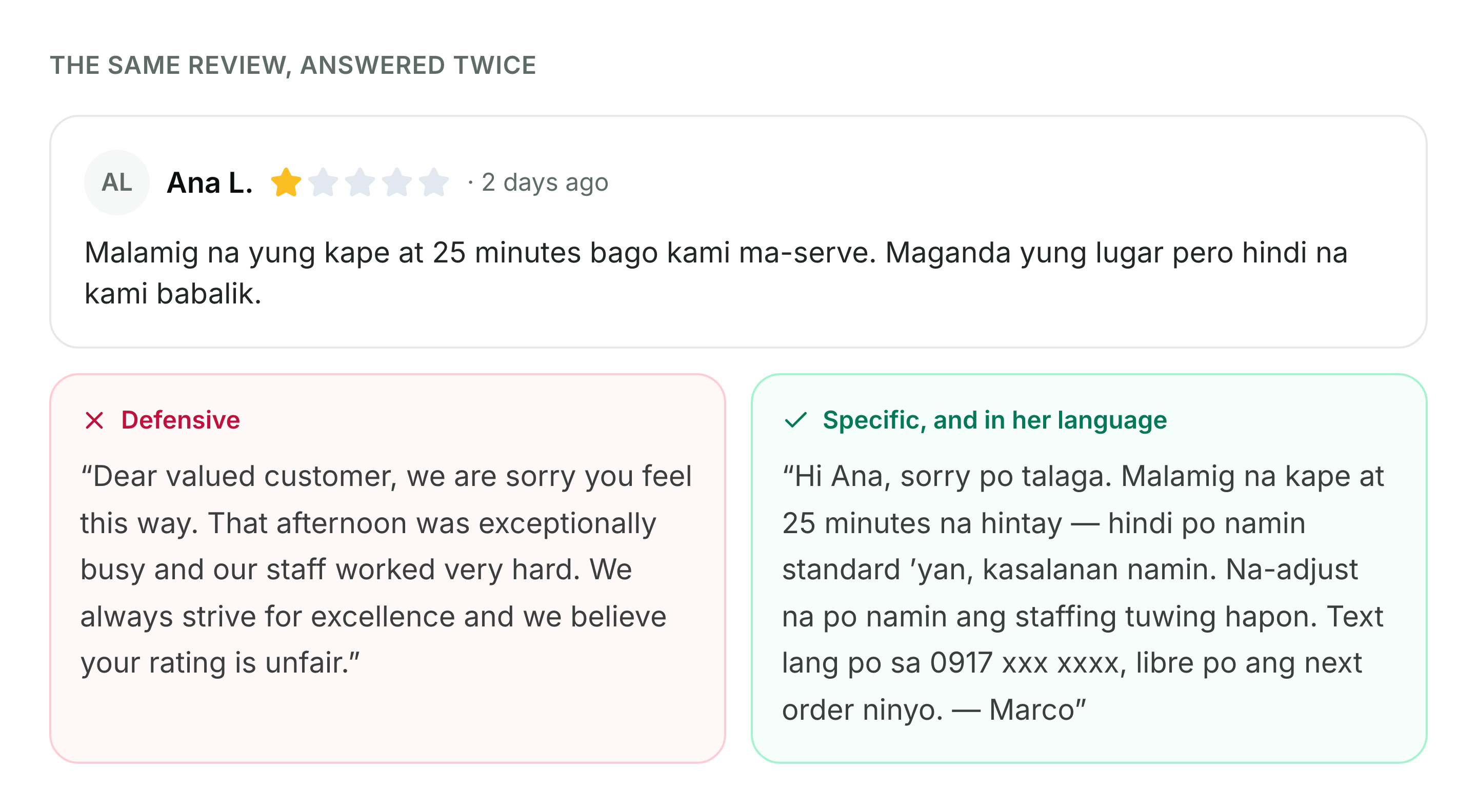
- Name them. "Hi Ana" reads like a person. "Dear valued customer" reads like a form.
- Thank them for saying it. Not for the rating — for taking the time to tell you.
- Acknowledge the specific thing. If they said the food was cold, say the food was cold. Vague regret reads as a script.
- Say what you are doing about it, concretely. "We have changed how we hand off orders at the counter" beats "we will strive to do better".
- Offer one way to continue privately, and mean it. A number, an email, a name.
Templates you can adapt
Use these as a skeleton, never word for word. A reply that appears verbatim under four different reviews is obvious to any reader scrolling your profile, and it undoes the point of replying at all.
Slow service, restaurant: "Hi Ana — thank you for telling us, and I'm sorry. Twenty-five minutes for a coffee is not acceptable and it was our fault: we were short one person on the bar that afternoon. We've changed how we staff the 3pm shift. If you'll give us another try, message me at 0917 xxx xxxx and the coffee is on me. — Marco, owner"
Bad haircut, salon: "Hi Jen, I'm sorry — that's not the result we want anyone leaving with. I've spoken to the stylist and we'd like to fix it at no charge this week if you're willing. Please text the shop at 0917 xxx xxxx and ask for me directly. — Rina"
Long wait, clinic: "Hi Paolo, thank you for the feedback and I'm sorry you waited. You're right that an hour past your appointment time is too long. We've cut the number of slots we book in the morning block so this happens less. If you'd like me to look at what went wrong that day, please email us at hello@clinic.ph. — Dr. Santos"
Taglish, when the customer wrote in Taglish: "Hi Ana, sorry po talaga sa naging experience ninyo. Hindi po namin standard 'yan, at kasalanan namin. Na-adjust na po namin ang staffing tuwing hapon. Kung papayag po kayo, mag-message lang po sa 0917 xxx xxxx — libre po ang next order ninyo. — Marco"
What not to do
Most of the damage owners do to themselves comes from four habits.
- Correcting them in public. Even when you are right, an owner arguing reads worse than the original complaint.
- Explaining at length. Anything over five sentences looks defensive, however reasonable it is.
- Mentioning their name as a customer in ways that reveal their visit. Their booking is their business, and depending on the detail it is a privacy problem.
- Replying twice. Say your piece once. A thread under a review makes the complaint taller on the page.
When it is not a real customer
Sometimes the review is from someone who never came, a competitor, or a mistaken business. You cannot delete it yourself, and Google only removes reviews that break its policies — not reviews that are merely unfair.
Report it through your Business Profile and then reply anyway, briefly and without accusation: "Hi — we can't find a booking under this name and we think this may be meant for another business. If we're wrong, please contact us at hello@shop.ph so we can put it right." That sentence is written for the reader, not for Google.
Expect most reports to be rejected. A steady flow of genuine new reviews pushes one unfair review down the page far more reliably than an appeal ever will.
Frequently asked
How fast should I reply to a bad review?
Within 24 hours. Readers can see the gap between the review date and your reply, and a same-day answer signals that someone is paying attention. If you need time to check what happened, reply anyway and say you are looking into it.
Should I reply in English or Taglish?
Match the customer. If they wrote in Taglish, reply in Taglish; it reads as a real person from the same place rather than a corporate account. If they wrote in English, stay in English.
Can I get a negative Google review deleted?
Only if it breaks Google's policies — spam, hate speech, conflicts of interest, or content unrelated to the business. An honest but unflattering review is not removable, and reporting it as though it were is a waste of time.
Does replying to reviews help my ranking?
Google says replying is good practice and it plainly affects whether readers choose you. Treat the ranking question as secondary: the reply is worth writing because of the person deciding whether to walk in.
Let Mapkita do this for you
Sync your listings, reply to reviews with AI, and track your rank — start with a free visibility audit.