What is franchising? Formats, roles and how to check one
What is franchising? How it works in the Philippines: the formats, who does what, how the money flows, the PFA, and how to check a brand before you sign.
Mapkita Team10 min read
Key takeaways
- Franchising is renting a proven system: the franchisor lends its brand, recipes and methods, and the franchisee runs a branch and pays for the right.
- Most franchises in the Philippines are business format franchises, from a food cart to a full salon or restaurant.
- Expect an upfront franchise fee plus ongoing fees. Ask for every fee in writing before you sign.
- Before you sign, check the brand's branches on Google Maps. Customers judge each branch on its own, not the brand's average.
What is franchising?
What is franchising? It is a way to grow a business by letting other people open branches of it with their own money. One company, the franchisor, owns the brand and a tested way of running the shop. Another person or company, the franchisee, pays for the right to open a branch under that brand and follows its system. The customer sees one brand; behind the counter, each branch can have a different owner.
The Philippine Franchise Association describes it as a method of distributing products or services. The franchisor sets up the trademark and the business system. The franchisee pays a royalty, and often an initial fee, to use them.
It is big business here. The 2025 Chambers guide to franchising law cites over 1,800 franchise brands and 120,000 franchise outlets in the Philippines. It calls the country the largest franchising market in Southeast Asia and the seventh largest worldwide, and says food is 60% of franchise opportunities.
Franchise or branch: what is the difference?
A company-owned branch belongs to the brand. Head office pays the rent, hires the staff and keeps the profit. A franchised branch belongs to the franchisee, who pays for the build-out, hires the crew and keeps what is left after fees. Many brands run both kinds side by side, and a customer usually can't tell which is which.
That last point matters more than it seems. On Google Maps every branch has its own profile, its own star rating and its own reviews. A customer choosing where to eat or get a haircut tonight sees the branch near them, not the brand's average.
What are the types of franchise in the Philippines?
The PFA names two classic types. In a product or trade name franchise, a maker lets you sell its products but gives you no method of running the business; car dealers and gas stations are the usual examples. In a business format franchise you get the whole plan: site selection, training, supplies, marketing and an operations manual. The PFA says modern franchising is mostly business format, and its members are business format franchisors.
Within business format franchising, Philippine brands come in a few sizes:
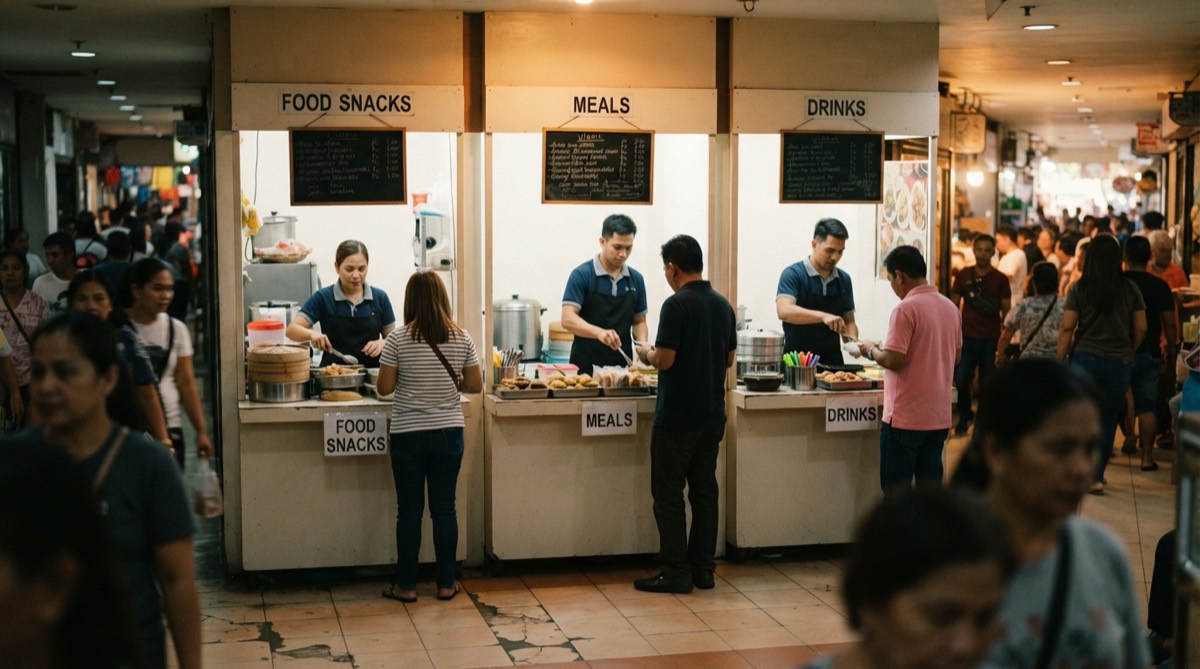
- Food cart and kiosk: a small counter in a mall, terminal or school area, one or two crew, a short menu. The cheapest way in, and the most crowded. See our guide to the food cart business.
- Stall or in-line store: a coffee counter, a milk tea shop, a laundry shop or a pharmacy, with a fixed menu and a small team. Our guide to choosing a coffee franchise shows how to compare them.
- Full store: a restaurant with dine-in, a salon, a spa or a clinic, with more staff, more equipment and bookings. Reviews weigh more here; see checking a salon franchise.
- Multi-unit or area deals: one franchisee opens several branches, sometimes of several brands, or gets the rights to a city or region.
Who does what in a franchise?
Roughly, the franchisor builds and protects the system and the franchisee runs the branch inside it. The detail is in the agreement, and it differs between brands. Our side-by-side guide to franchisor vs franchisee goes line by line.
- Franchisor: owns the brand and trademark, develops the products and writes the operations manual. It trains the franchisee and the crew, approves the site and store design, sets up suppliers, runs brand-wide marketing and audits the branches.
- Franchisee: puts up the money, finds or leases the site, hires and pays the staff, runs the branch every day to the manual, buys supplies from the approved list, does local marketing and reports sales.
- Both: the branch's reputation. A bad week at one branch shows up in its Google reviews under the brand's name, and the next customer doesn't know or care who owns it.
How does the money work, in general?
Every brand prices its franchise differently and changes it over time, so we won't quote figures. The structure is usually similar. Most charge a franchise fee plus a monthly royalty, and many add a marketing fund contribution. Ask for every one of these in writing, with what it pays for.
- Franchise fee: paid once, for the right to use the brand and for the initial training. Ask what it includes and whether any of it is refundable.
- Build-out and equipment: the cart, kiosk or store fit-out, usually to the brand's design and sometimes through its contractor.
- Initial stock and supplies: often bought from the franchisor or its approved suppliers.
- Royalty: a recurring fee, often a share of sales or a fixed monthly amount.
- Marketing fund: a recurring contribution to brand-wide advertising. Separate from the money you spend on your own branch's local store marketing.
- Other recurring costs: POS or software fees, renewal fees when the term ends, deposits and transfer fees if you sell.
How does buying a franchise work, step by step?
The order varies by brand, but most buyers go through something like this:
- 1. Shortlist brands. Start from the PFA's member directory, friends who own branches, and a franchise expo, where hundreds of brands sit under one roof.
- 2. Check the branches. Read the Google reviews of 5 to 10 existing branches and visit 2 or 3 as an ordinary customer, the way a mystery shopper would.
- 3. Inquire and apply. Most franchisors ask for an application form and an interview, and some ask for proof of funds.
- 4. Get a site approved. The franchisor usually has rules on foot traffic, distance from other branches and space.
- 5. Read and sign the agreement. Have a lawyer read it before you sign.
- 6. Train. You and your crew learn the products, the routines and the standards, often at an existing branch.
- 7. Build and stock the branch.
- 8. Open. A soft opening before the grand opening gives the crew a few days to find the problems. Set up the branch's Google profile before day one.
- 9. Run it. Daily operations are yours; the franchisor audits, coaches and sometimes sends area managers.
What does the PFA do?
The Philippine Franchise Association is a voluntary, self-regulatory organization. Its members follow the Fair Franchising Standards, its code of ethics, and it organizes Franchise Asia Philippines, the big yearly expo in Manila. It also keeps a members' directory you can filter by sector and investment level, and runs regional expos and training.
Membership isn't a guarantee, but it is a useful first filter. Our guide to the Philippine Franchise Association explains what it checks and how buyers and new franchisors use it.
How do you check a franchise brand before you sign?
Start with the PFA's advisory on franchise scams. It asks who is behind the brand and whether it has a real franchising track record. It asks whether the agreement and the operations manual are detailed, whether the franchisor owns its trademark and system, whether it belongs to a legitimate association and whether it gives training and support. It warns against pressure tactics and offers that are too good to be true. Trademark registrations are handled by the Intellectual Property Office of the Philippines.
Then look at the branches. Take a Mapkita sample of 1,646 Metro Manila branches of 35 chain brands on Google Maps (October 2026). The median gap between a brand's best and worst branch was 2.9 stars, and 47% of rated branches were below 4.0. The same brand can be excellent at one address and poor at another. The full numbers are in our study of how franchise branches rate on Google, and our guide to checking a franchise's reviews before you buy shows the method step by step.
Use this checklist for each brand on your list:
- Pick 5 to 10 branches on Google Maps, including some far from head office. Write down each one's rating and number of reviews.
- Sort the reviews by newest and read the last 3 months. Then read every 1 to 3 star review and note complaints that repeat across branches.
- Check whether anyone replies to reviews, and whether the replies answer what the customer said.
- Count reviews, not only stars. In the same sample, branches with fewer than 20 reviews had a median of 3.7 stars; a handful of angry customers decide their rating.
- Visit 2 or 3 branches at a busy hour. Order the best-seller and time it.
- Talk to at least 3 current franchisees you found yourself, not only the ones the franchisor suggests.
- Ask who will own your branch's Google profile and who answers its reviews. Our guide to Google Business Profile for franchises explains the options.
What are the advantages and disadvantages of franchising?
For the buyer, franchising trades freedom for a head start. Whether that trade is good depends on the brand and on you.
- Advantage: a brand people already know, so the first customers come sooner than for an unknown shop.
- Advantage: a tested menu or service list, a manual and training, so you don't learn everything by trial and error.
- Advantage: the brand's buying power with suppliers, and help choosing a site.
- Disadvantage: fees continue whether or not the branch makes money.
- Disadvantage: little room to change the menu, the prices, the look or the suppliers.
- Disadvantage: other branches' mistakes land on your brand. A viral complaint about another branch can keep customers away from yours.
- Disadvantage: when you want to leave, the agreement decides how, when and to whom you can sell.
What happens after you open?
Once your branch is open, the job becomes operations: the crew, the stock, the daily cleaning, and how customers talk about you. These guides cover the people and routines behind a well-run branch:
- The daily, weekly and monthly checklist for store manager duties.
- What an area manager does across many branches, with a scorecard: the area manager job description.
- Measuring whether customers would recommend you with a net promoter score.
- Watching and answering what people say about every branch: online reputation management.
- A brand's written rules for answering reviews: review response guidelines.
- Closing a branch or moving it to a new address on Google: mark a business permanently closed on Google.
- From day one, give your branch its own Google review link so customers land on the right branch, not on another one with the same name.
Can you franchise your own business?
Yes, if you have a shop that works without you standing in it. Owners usually start thinking about it after 2 or 3 branches that run well, and the hardest part is writing down everything that makes those branches good. Our guide on how to franchise a business walks through the readiness checks, the operations manual and where to get help.
Frequently asked
- What is franchising in simple terms?
- Franchising is when a business lets other people open branches under its name and system, in exchange for fees. The franchisor owns the brand and the method; the franchisee owns and runs the branch and follows the franchisor's rules.
- What is the difference between a franchise and a branch?
- A company-owned branch belongs to the brand itself. A franchised branch belongs to an independent owner, the franchisee, who paid for it and keeps its profit after fees. Customers usually can't tell them apart, and both carry the same name on Google Maps.
- What is the difference between franchising and licensing?
- A licence usually gives the right to use a name, a product or a technology and little else. A business format franchise gives the brand plus the whole way of running the shop: the manual, training, suppliers, store design and ongoing support, along with rules you must follow.
- What is franchising in Tagalog?
- Most Filipinos simply say franchise, as in mag-franchise or nag-franchise ng food cart. The Tagalog word prangkisa exists, but it is also used for transport franchises from the LTFRB, which are a different thing.
- Is franchising better than starting your own business?
- It is not better or worse, it is a different trade. A franchise gives you a known brand and a tested system but costs fees and limits what you can change. Your own business is cheaper to start and fully yours, but you build the name and the system from nothing.
Let Mapkita do this for you
Mapkita keeps your Google page right, drafts every review reply and asks you before anything goes public. Start with a free check.