Local store marketing: a 30-day plan for one branch
Local store marketing for a franchise or chain branch in the Philippines: who pays for what, a 30-day plan, ideas for your area and the numbers to watch.
Mapkita Team8 min read
Key takeaways
- Local store marketing (LSM) is what one branch does to win customers within a short walk or ride. Brand ads make people know the name; LSM makes them choose your branch.
- In many franchises the franchisor runs the brand-wide marketing fund and the franchisee runs local marketing. Get the split and the approval rules in writing.
- Start with the branch's Google profile. Almost every flyer, tie-up or event ends with someone checking the branch on Google Maps.
- Run it as a 30-day plan with one goal and one number to watch. Keep what worked, drop the rest, repeat.
What is local store marketing?
Local store marketing (LSM) is the marketing one branch does for its own neighbourhood: the offices, schools, condos, parishes and barangays within a short walk or ride of the store. The brand's TV spots, social pages and national promos make people know the name. Local store marketing gives the people nearby a reason to pick your branch this week, over the one two floors up or the stall across the street.
The term is common in franchising. The Philippine Franchise Association's 2026 Franchisee Summit had a whole session on it, described as "franchisee-driven insights and proven local store marketing (LSM) strategies". It works the same way in a company-owned chain, where the store manager or area manager runs it.
This guide covers who pays for what, why the branch's Google profile comes first, a 30-day plan you can copy, ideas that fit a Philippine branch, and how to tell whether any of it worked.
Brand marketing fund vs local store marketing: who pays for what?
Many franchise systems split marketing in two. The franchisor collects a marketing fund, often a percentage of each branch's sales, and spends it on brand-wide campaigns. Consultancies such as Francorp help new franchisors decide "what percent of sales franchisees must contribute to regional or national advertising". Local store marketing sits on top of that, and it is often the franchisee's own time and money. If you are still deciding who does what, our franchisor vs franchisee guide lays out the usual split.
Before you plan anything, ask head office these questions. The answers are often already in the operations manual.
- What does the marketing fund pay for, and does any of it come back to my branch as materials or local campaigns?
- Is there a required local marketing spend each month, and how do I report it?
- Which materials need approval before use: flyers, tarpaulins, social posts, promos, sponsorships?
- Can I run my own branch promo, or only the brand's national ones?
- Who owns and manages my branch's Google Business Profile and Facebook page, and can I post on them?
- Where is the brand kit: logo files, fonts, approved photos and templates?
Why the branch's Google profile comes first
Every flyer, tarpaulin and office visit ends the same way. Someone searches the branch on Google Maps to check the hours, look at the photos and read the reviews. If the profile shows the wrong hours or three reviews from 2023, the flyer did its job and the profile undid it. Each branch needs its own profile; see Google Business Profile for multiple locations.
Reviews also affect who finds the branch at all. Google's own guide says "more reviews and positive ratings can help your business's local ranking". Many branches start far behind: in a Mapkita sample of 1,646 Metro Manila branches of 35 chain brands on Google Maps (October 2026), 36% had fewer than 10 reviews. The full branch ratings study has the numbers by category.
Fix these before you spend a peso on print. If head office manages the profile, send them the list; Google Business Profile for franchises explains who usually holds which role.
- Hours match the real ones, including mall hours and the next holiday.
- The branch name matches the brand's name exactly, with no promo or "near" text added.
- At least 10 recent photos of this branch: the front, the counter, the staff at work, the products as served.
- Every review from the last 3 months has a reply, newest and worst first.
- A Google post for the month's local event or offer. Google archives posts older than 6 months unless they have a date range.
A 30-day local store marketing plan: week 1, map and fix
Pick one goal for the month and one number that shows it, for example weekday lunch transactions, new loyalty members, or bookings on slow days. Write down where that number is today. Then work through the four weeks.
- Day 1: draw a circle of about 1 km around the branch on a printed map. In a mall, list the offices and condos within walking distance of the mall too.
- Days 2 to 3: list 20 neighbours by name: offices, schools, condo admins, gyms, clinics, parish office, barangay hall, the mall's marketing team.
- Days 3 to 5: fix the Google profile using the list above, and get any materials you plan to use approved by head office.
- Days 5 to 7: write down your baseline: transactions per day, average ticket, new reviews per week, and your goal number.
Week 2: talk to your neighbours
Many branches skip this week, yet the relationships it starts can last for years. Go in person, with something to leave behind.
- Visit 5 offices or condo admins from your list. Offer something simple and approved: a bulk order for meetings, a staff card, a standing weekly delivery.
- Ask the mall's marketing team for their activity calendar and any open slots for sampling or a booth.
- Give each partner a code or card unique to them, so you can count what each one brings in.
- Put a loyalty card on the counter for regulars; a free loyalty card maker prints one in minutes.
Week 3: show up once, in person
Pick one event, not five. A branch team of four can run one well.
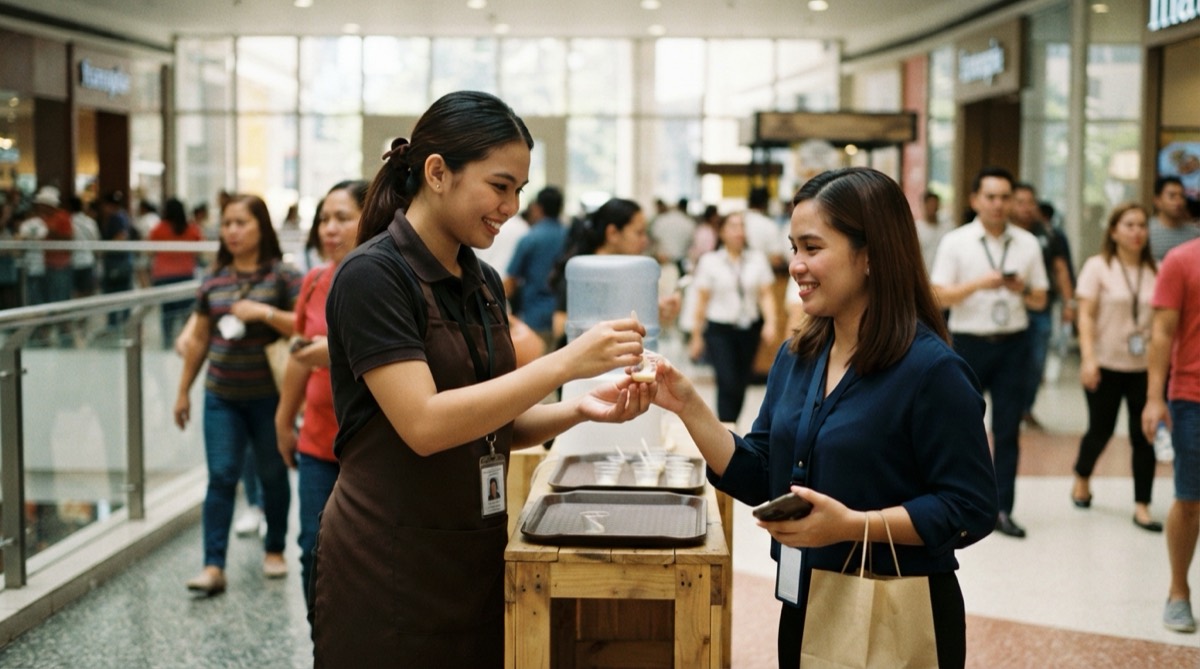
- Sampling at the mall atrium or your branch entrance during the lunch rush.
- A booth at a school fair, a parish or barangay fiesta, or a sponsored team in the local liga.
- A small in-store event for one partner: a team lunch, a birthday group, a class reunion.
- Post the event on the Google profile and the branch's Facebook page a few days before, with the date and time.
Week 4: measure, keep, repeat
Compare the month against your baseline. Keep the one or two things that moved your number, drop the rest, and plan next month around them. Write a half-page report for head office or the area manager: what you did, what it cost, what changed.
Payday weekends around the 15th and the end of the month are natural dates for next month's push, since that is when many offices around you get paid.
Local store marketing ideas that fit a Philippine branch
Choose ideas that match who walks past your branch. A coffee kiosk near a call centre and a salon in a residential strip need different plans.
- Office tie-ups: a company ID deal, meeting catering or a monthly bulk order for a nearby BPO or bank branch.
- Schools and universities: exam-week hours, org event catering, a student combo at the times students actually pass by.
- Condos and subdivisions: a notice on the admin's board or in the residents' group chat, with the admin's permission.
- Parish and barangay: fiesta booths, sponsoring a liga team, feeding programs. Visible, local and remembered.
- Mall calendar: tie into the mall's own sale days and activities, which bring the foot traffic for you.
- Neighbour cross-promos: a gym and a smoothie stall, a salon and a coffee shop, each handing out the other's card.
- Local Facebook groups: community and buy-and-sell groups, following each group's posting rules.
- Regulars first: a loyalty card or a stamp program rewards the people already coming, which is cheaper than finding new ones.
How to measure local store marketing
Keep a simple sheet with one row per activity: the date, what you did, what it cost, and what came back. Three kinds of numbers are enough.
- Sales: transactions per day and average ticket, compared with your week 1 baseline.
- Redemptions: how many partner codes, cards or coupons came back, per partner.
- Google: calls, direction requests and profile views in the Business Profile performance report, plus new reviews per week.
- Loyalty: new members and how many came back a second time within the month.
What not to do
A few local tactics cost more than they bring in, and some break Google's rules.
- Don't trade freebies or discounts for reviews. Google's review policy bans incentives, asking only happy customers, pressuring customers on the premises and staff review quotas. Ask every customer the same way, or not at all.
- Don't put promos in your replies to reviews. Google's reply tips say replies are not the place for offers.
- Don't add a promo or "near" text to the branch name on Google. All branches use the brand's name.
- Don't print your own version of the logo or menu. Off-brand materials are the fastest way to a call from head office.
- Don't run five things at once. You won't know which one worked.
Frequently asked
- What is local store marketing?
- Local store marketing (LSM) is the marketing a single branch does for the people near it: offices, schools, condos, parishes and barangays within a short walk or ride. It works alongside the brand's own advertising and gives nearby customers a reason to choose that branch.
- What are examples of local store marketing?
- Common examples are office tie-ups and bulk orders, sampling at the mall entrance, a booth at a school fair or barangay fiesta, sponsoring a local sports team, cross-promotions with a neighbouring shop, a loyalty card for regulars, and keeping the branch's Google profile correct and its reviews answered.
- Who pays for local store marketing in a franchise?
- It depends on the franchise agreement. In many systems the franchisor runs a brand-wide marketing fund paid from a percentage of sales, and local store marketing is the franchisee's own spend on top. Ask the franchisor for the split, any required local spend, and the approval rules, in writing.
- What does a local store marketing officer do?
- In chains that have the role, an LSM officer or coordinator helps a group of branches plan and run local campaigns: partner visits, events, materials and approvals. They track what each activity cost and brought in, and report it to the area manager or marketing team.
- What is the primary purpose of local store marketing?
- To bring more customers from the neighbourhood into one specific branch, and to get them coming back. Brand advertising builds awareness of the name; local store marketing turns that awareness into visits at your door.
Let Mapkita do this for you
Mapkita keeps your Google page right, drafts every review reply and asks you before anything goes public. Start with a free check.