Customer retention: how to know if your customers are loyal
Measure customer retention in a small shop without software: a two-week notebook count, the repeat rate formula, the suki test and what to do this week.
Mapkita Team7 min read

Key takeaways
- Customer retention is the share of your customers who come back. A notebook by the register with a "Suki" column and a "Bago" column measures it in two weeks.
- Repeat rate = customers who bought more than once ÷ all customers in the same period. 28 repeat names out of 80 Messenger customers is a 35% repeat rate.
- There is no universal good number. Beat your own last month, and watch for regulars whose visits are spacing out.
- A 2024 study that interviewed 10 vendors in Diffun Public Market, Quirino, found they keep their suki through product quality, the seller's personality and pricing: cheaper prices and allowing credit.
What customer retention means for a small shop
Customer retention is how many of your customers come back. For a café, carinderia, salon or sari-sari store, you can measure it without software. Count how many of the people you served in a set period had been in before, and compare that with everyone you served.
That one number answers the question owners actually ask: are my customers loyal, or am I starting from zero every day? It also tells you whether what you try next, a stamp card, a new menu, a friendlier counter, is working.
Regulars are worth the effort. A well-known 1990 Harvard Business Review study of service companies found that long-term customers buy more each year, cost less to serve and bring others by word of mouth. Reducing customer defections by 5% raised profits by 85% in one bank's branches, 50% at an insurance broker and 30% at an auto-service chain. Your shop is smaller, but the logic is the same: the suki who eats with you four times a week is your business.
How to measure customer loyalty without software
Pick two or three of these. Each takes a few minutes a day, and together they give you a picture you can trust.
- The notebook count: for two weeks, keep a sheet by the register with two columns, "Suki" and "Bago". Staff make one tick per customer. If they're not sure, they ask "First time niyo po dito?" and tick the right column.
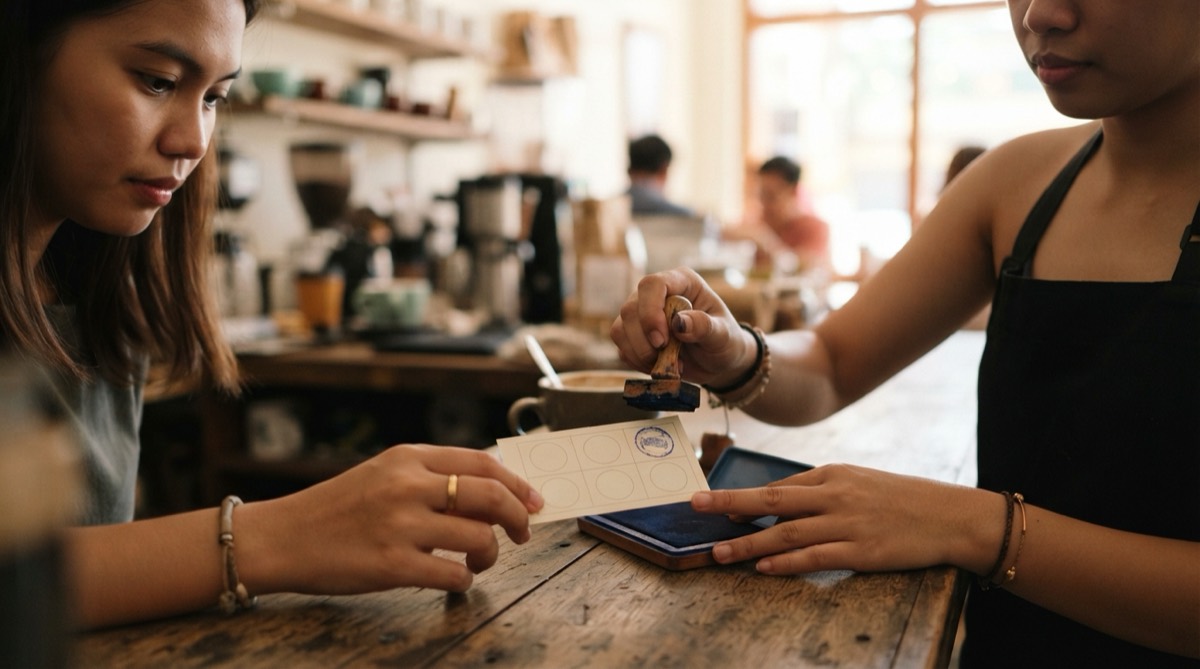
- The full-card count: if you use a stamp card, write down how many cards you hand out each month and how many come back full. A card that never returns is a customer who didn't either.
- The chat count: if you take orders on Messenger or Viber, your chat list is already a customer list. Scroll back 30 days and count the names that ordered more than once.
- The app count: delivery apps track this for you. The GrabMerchant portal's Insights, for example, show new, existing and returning customers (GrabMerchant). Dashboards change, so check what yours shows today.
- The name test: sit down with your staff and write every regular you can name, with their usual order. If the list is short, or only you know the names, that is a finding too.
- The listahan: in a sari-sari store, the list of customers who buy on credit is a list of your most loyal customers. Note who has stopped coming, not only who owes.
Repeat customers: the formulas, with worked examples
There are four simple numbers. Use the same period every time, two weeks or one month, so you compare like with like.
Use the repeat rate when you want to know how many of a period's customers bought again. Use the retention rate when you have a customer list (Messenger chats, a booking book, the listahan) and want to know how many of the people you started with you kept.
- Share of regulars (from the notebook count): Suki ticks ÷ all ticks × 100. Example: a carinderia near a jeepney stop makes 600 ticks in two weeks, 390 of them in the Suki column. 390 ÷ 600 = 65% of its customer visits came from regulars.
- Repeat rate (from names): customers who bought more than once ÷ all customers × 100. Example: an online seller had 80 different customers on Messenger in September, and 28 of them ordered at least twice. 28 ÷ 80 = 35%.
- Customer retention rate (from a customer list): (customers at the end of the period − new customers in the period) ÷ customers at the start × 100. Example: an online seller has 50 Messenger customers on 1 September, gets 12 new ones during the month, and has 45 on 30 September. (45 − 12) ÷ 50 = 66%.
- Full-card rate (from stamp cards): full cards returned ÷ cards handed out. Example: 100 cards handed out in July, 22 back full by the end of September, so 22%.
- Compare with yourself: count again next month. Up is good. Down two months in a row means something changed: a price, a staff member, a new stall across the street.
- Ignore benchmarks from the internet. A laundry shop, a milk tea kiosk and a salon have different rhythms, so your own last month is the number to beat.
The suki relationship: customer loyalty, Filipino style
Filipino retail already has a word for a loyal customer. The KWF dictionary defines suki as anyone who regularly buys from a store or uses a service, and traces the word to Chinese. In everyday use it runs both ways: the customer is your suki, and you are theirs.
A 2024 study of small vendors in Diffun Public Market, Quirino asked how they keep their suki. Three things came up: product quality (clean, fresh, dependable), the seller's personality and how they talk to customers, and pricing, including cheaper prices and letting trusted customers pay later.
None of that needs an app. It needs consistency, memory and fairness, which is what the rest of this page is about.
Customer retention strategies: how to keep customers coming back
In Tagalog, customer retention is simply keeping your suki, or "pagpapanatili ng customer" if you want the literal term. Most regulars come back for a few plain reasons. Protect these before you add anything new.
- The same taste and the same portion every time. A regular notices a smaller scoop of rice before you do.
- Being remembered. "Yung dati po?" (the usual?) is the simplest loyalty program in the country. Teach every staff member the names on your list.
- Fair treatment on a bad day. A wrong order fixed quickly keeps a regular; one argued about loses them. See how to handle angry customers.
- Hours you keep. If you close early for a typhoon or a fiesta, post it on your Facebook Page and set special hours on Google, so nobody walks to a locked door.
- A small reason to choose you over the next stall: a stamp card, an extra for suki on payday, or a message when their favourite is back. A simple loyalty program covers what to offer.
- Being asked. A short customer satisfaction survey catches the problem a regular would never say to your face.
Warning signs a loyal customer is drifting
Customers rarely announce they're leaving. They come a little less, then not at all. Watch for these:
- Visits spacing out: twice a week becomes once, then every other week.
- Smaller orders: the full meal becomes rice and one ulam, or the haircut skips the usual treatment.
- A half-full stamp card that hasn't moved in a month.
- Messenger orders that stopped, especially after a late delivery or a mistake.
- A complaint that ended without a fix, or with a staff member arguing.
- Quiet at the counter: a regular who used to chat now pays and leaves.
Your customer retention plan for this week
When you spot a regular drifting, reach out once, as a person, with no sales pitch. The HBR study above recommends the same for big companies: find the customers who left, ask them why, and act on the answer.
Here is a week that gives you your first numbers and reaches at least one regular you were losing.
- Monday: put the tally sheet by the register, with Suki and Bago columns. Brief staff in two minutes.
- Tuesday: with your staff, list every regular you can name and their usual order. Keep it inside the counter, not on the wall.
- Wednesday: scroll your Messenger or Viber orders back 30 days and count repeat names.
- Thursday: message one regular you haven't seen in three weeks. English: "Hi [name], it's [your name] from [shop]. We haven't seen you in a while, hope you're okay. Was there something you didn't like last time? Tell us and we'll fix it." Taglish: "Hi [name], si [your name] po ito ng [shop]. Matagal na po kayong hindi napapadaan, okay lang po ba kayo? May hindi po ba kayo nagustuhan nung huli? Sabihin niyo lang po para maayos namin."
- Friday: if you don't have one, print a stamp card for your shop so next month you have a second measure.
- In two weeks: add up the ticks, work out your share of regulars, and write it at the top of a page. Do it again next month.
Frequently asked
- What is customer retention?
- Customer retention is how many of your customers keep coming back over time. A small shop can measure it by counting returning customers against all customers in a set period, such as two weeks.
- How do you calculate customer retention rate?
- Take the customers you have at the end of the period, subtract the new ones you gained during it, divide by the customers you had at the start, and multiply by 100. For example, (45 − 12) ÷ 50 = 66%.
- How do you measure customer loyalty in a small business?
- Count it. Tick regulars and new faces in a notebook for two weeks, track how many stamp cards come back full, and count repeat names in your Messenger or delivery app orders. Compare the numbers month to month.
- What does suki mean?
- Suki means a regular customer: someone who keeps buying from the same store or using the same service. The KWF dictionary traces the word to Chinese, and in everyday use it also describes the seller a customer keeps returning to.
- How do I keep customers coming back?
- Keep the product and portion consistent, remember regulars' names and orders, fix mistakes quickly, keep the hours you post, and give a small reason to return, such as a stamp card.
Let Mapkita do this for you
Mapkita keeps your Google page right, drafts every review reply and asks you before anything goes public. Start with a free check.